For Clinics And Hospitals
Calm The Waiting Room.Everyone Knows Their Place.
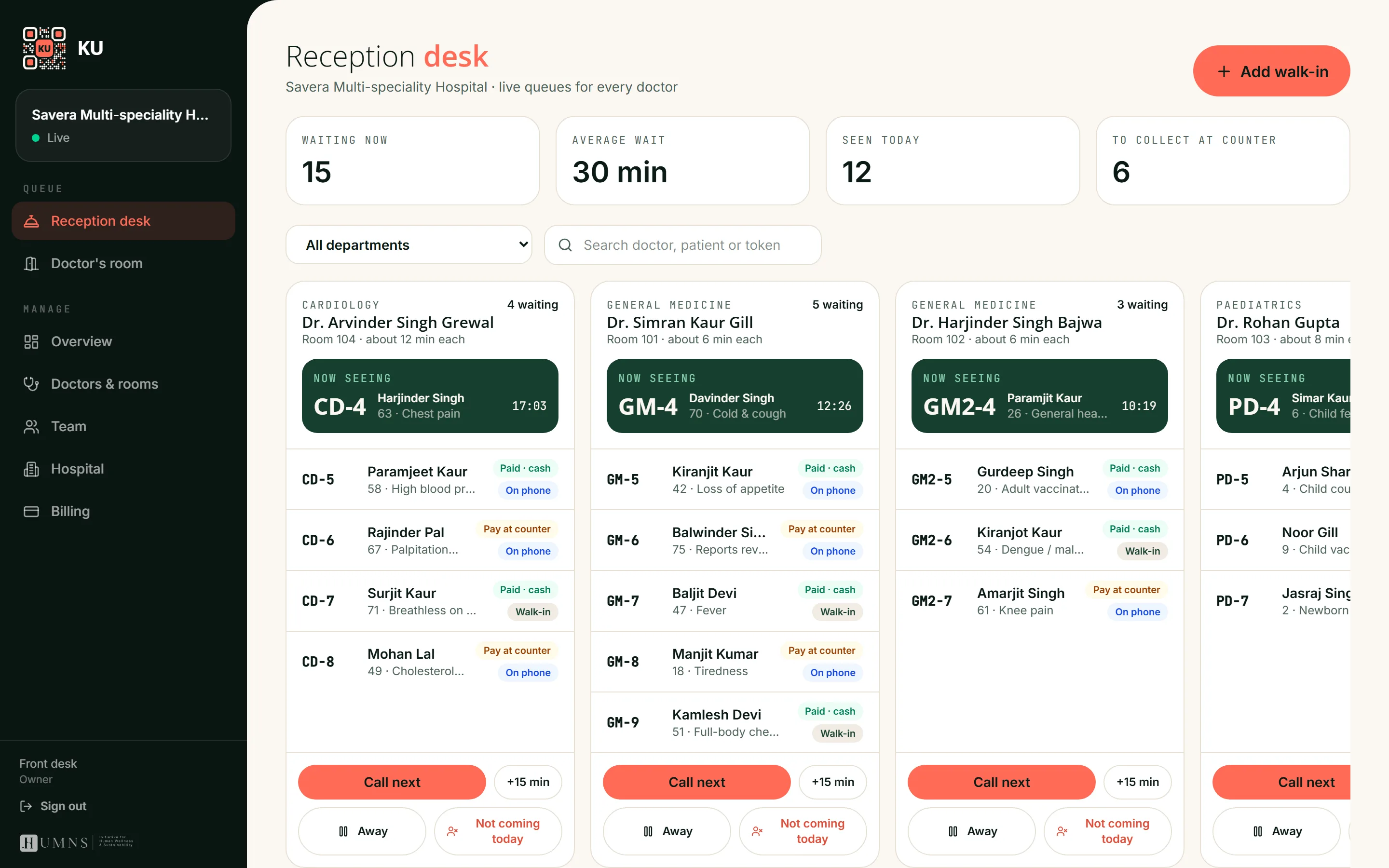
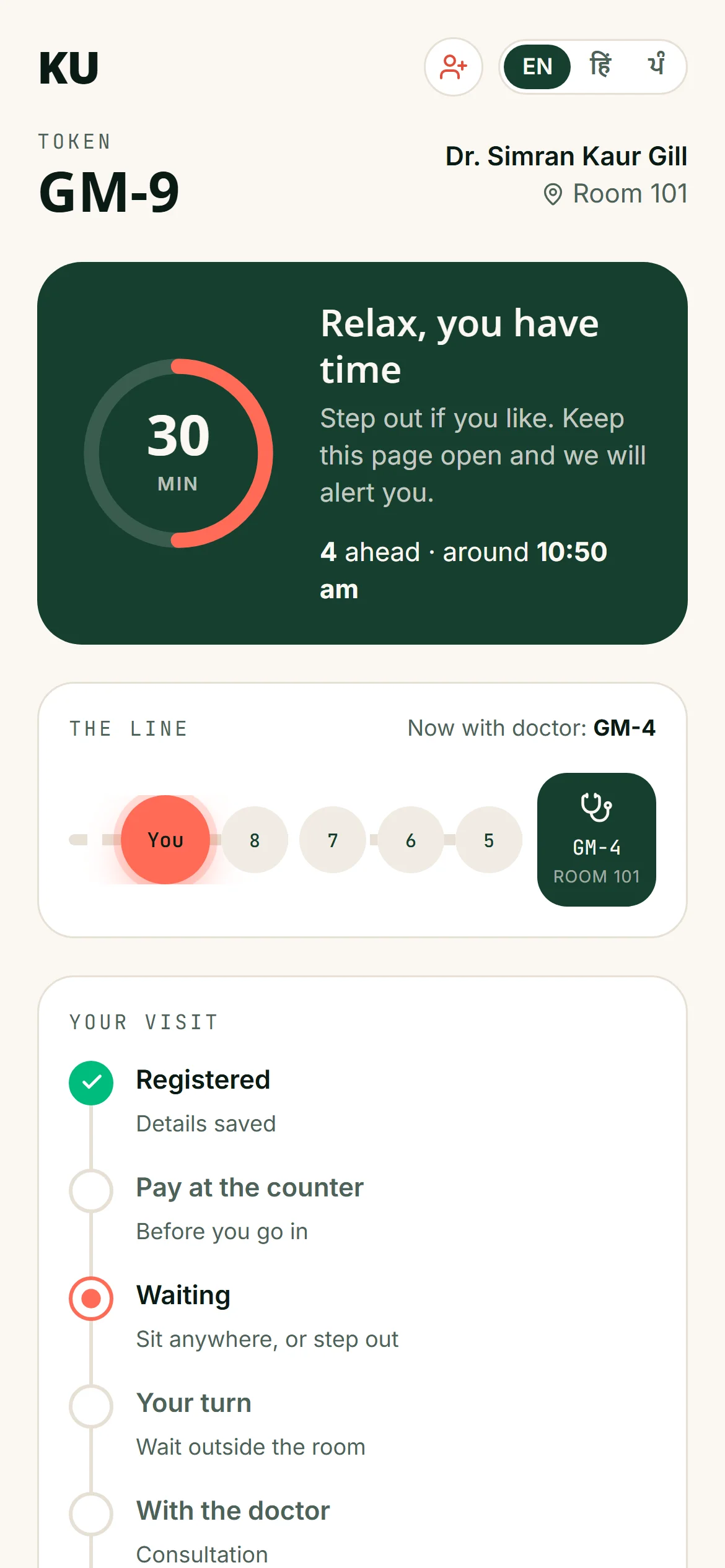
KU gives each patient a token on their own phone and a live view of where they are in the line. They can sit, step out or fetch tea, and KU tells them when to come back. Reception and doctors run every line from one screen. No app to install, and nothing to buy.
In your patients’ own language · Any phone · Patient details wiped every night
Why This Matters
The Wait Is WhereThe Frustration Starts
A crowded corridor, no idea how long it will be, and a desk that has to answer the same question fifty times a day. Nobody’s morning gets better, and the people at the front carry it.
These are the numbers we could check against their sources.
8–38%
Of health workers suffer physical violence
Between 8% and 38% of health workers suffer physical violence at some point in their careers, and most of it comes from patients and visitors.
WHO, Preventing violence against health workers62%
Waited over 30 minutes to see a doctor
In a government audit of outpatient departments in Jammu and Kashmir, 62% of patients at tertiary hospitals waited more than 30 minutes to see a doctor, and 58% of all patients were examined for under five minutes.
CAG Report No. 2 of 2025, as reported by Daily Excelsior59 min
Average wait at one teaching hospital
In a 2023 study of 80 outpatients at Sassoon General Hospital in Pune, the average wait was 59 minutes, and patients who waited less were significantly more satisfied.
Int J Community Med Public Health, 2023A queue tool cannot promise to end conflict, and these studies do not show that waiting causes violence. They show that long waits are common, that they lower patients’ satisfaction, and that most violence against health workers comes from patients and visitors. KU removes the part a clinic can change: the not knowing.
How It Works
From The Door To The Doctor
Four steps for the patient, and what the clinic sees at each one.
Scan the clinic’s code
The patient
Opens in the phone’s browser. No app to install. Choose your own language on the first screen.
The clinic
Print the poster once. There is no equipment to buy or fit.
Get a token
The patient
Name, phone, the reason for the visit, and the doctor. Pay at the counter as you always have.
The clinic
Reception can issue a walk-in token in a few seconds, from the same screen.
Follow the line live, from anywhere
The patient
A live place in line, with an alert at three ahead and when it is their turn. Sit, step out, or have tea.
The clinic
One screen shows every doctor’s line, who is inside and who is next.
Called in, fairly
The patient
Told which room to go to, with five minutes to get there. Late is not lost: they can still be fitted in.
The clinic
The doctor taps Call next. KU handles skips and recalls by clear rules, so nobody argues about who was first.
What You Get
Everything A Queue Needs, Nothing It Doesn’t
Built for a busy front desk, and for the day things do not go to plan.
A live place in line, on the patient’s own phone
No app, no account, no equipment. Patients see how many are ahead and get alerted inside KU when it is nearly their turn.
In your patients’ own language
Patients pick their language on the first screen and can switch at any time, with doctors’ names and reasons for the visit shown in it too. More Indian languages are being added as we grow.
Reception and doctor screens, in real time
A click at the desk shows everywhere within a second. A doctor sees their own room; reception sees every line. Nobody sees another clinic’s data.
Doctor late, on a round, or not coming? One tap
Mark it, and every patient waiting is told. If a doctor will not come at all, patients can take the next date with the same doctor, or another doctor today, with nothing more to pay.
Fair rules, built in
One patient inside at a time. Priority patients go first. A called patient has five minutes to arrive, and a late one can still be fitted in within fifteen minutes of the call.
It learns how long your doctors really take
There is nothing to estimate or type in. KU watches real visits and the waits it shows get more accurate day by day.
Book a day ahead, without a time slot
Patients pick the day. On the morning, their token number and arrival time appear, never giving less than two and a half hours’ notice.
A saved photo of the code is no use
Tokens are only given during OPD hours, so nobody can scan from home at midnight and take a place in tomorrow’s line.
Privacy By Design
Patient Details Are Kept For One Day
Every night, names, phone numbers and reasons for the visit are removed from finished tokens. What remains is a plain record of times and doctors that your clinic can count, and nobody can be identified from it. Only advance bookings are kept, until their day.
One clinic never sees another
Each clinic’s patients, tokens and staff are separated by the database itself, not just by the screens.
Private links, no names on display
A patient’s token opens on a private link. Anything shown to a waiting room carries token numbers only.
Only the people who need it
Reception runs the desk; a doctor sees their own room; the owner manages the team. Everyone signs in with a one-time code.
Pricing
Simple, Per Doctor
One simple price per doctor. Add or remove doctors yourself and the price follows.
KU for clinics
₹299 per doctor, per month
Never less than ₹799 a month. Paid upfront. Plus GST.
How many doctors?
- Every feature on this page, for every doctor
- Reception, doctor and owner logins, as many as you need
- Your patients’ own language on every screen
Questions
Good To Know
Ready To Calm Your Waiting Room?
Tell us about your clinic and we will get you set up. Your reception can be running the line within days.
Request access